Introducing the Classic Mini DIY 3D Model Library
The parts you can't buy anymore, now printable. Introducing the Classic Mini DIY 3D Model Library — browse, print, and share.

If you've owned a Classic Mini for any length of time, you know the routine: you need one small part, and the trail goes cold. It's discontinued, it's £40 plus shipping from across the world, or it never really existed as a spare in the first place. The car's been out of production since 2000, the long tail of little plastic and metal bits gets thinner every year.
Here's the good news: a huge amount of that long tail is now printable. And today I'm excited to open up a proper home for it.
A library built for the Mini
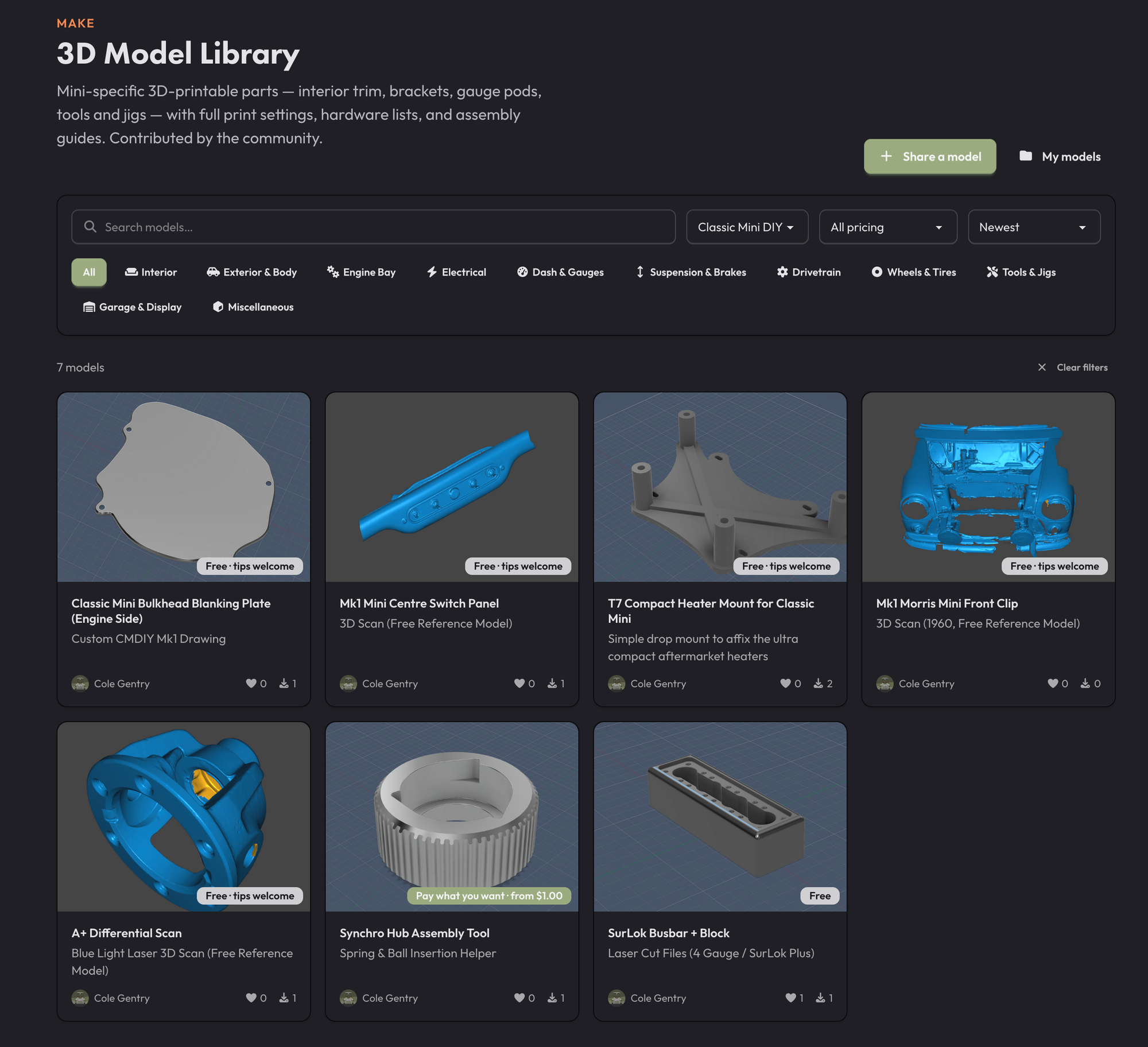
The 3D Model Library is a new section of Classic Mini DIY where the community can browse, download, and share 3D-printable parts for the Mini — interior trim, dash and gauge mounts, engine-bay brackets, electrical bits, tools and jigs, garage-display pieces, and plenty more. It's organized by the kind of categories that actually make sense for our cars, so you can go straight to what you need.
Everything you need to actually print it
Anyone can post an STL. What's harder to find is the context that makes a print succeed on the first try. So every model in the library can carry:
- Print settings — recommended material, layer height, infill, wall count, supports, and notes
- A hardware list — the bolts, inserts, and bits you'll need to finish the job
- Assembly notes — difficulty, tools, and step-by-step where it helps
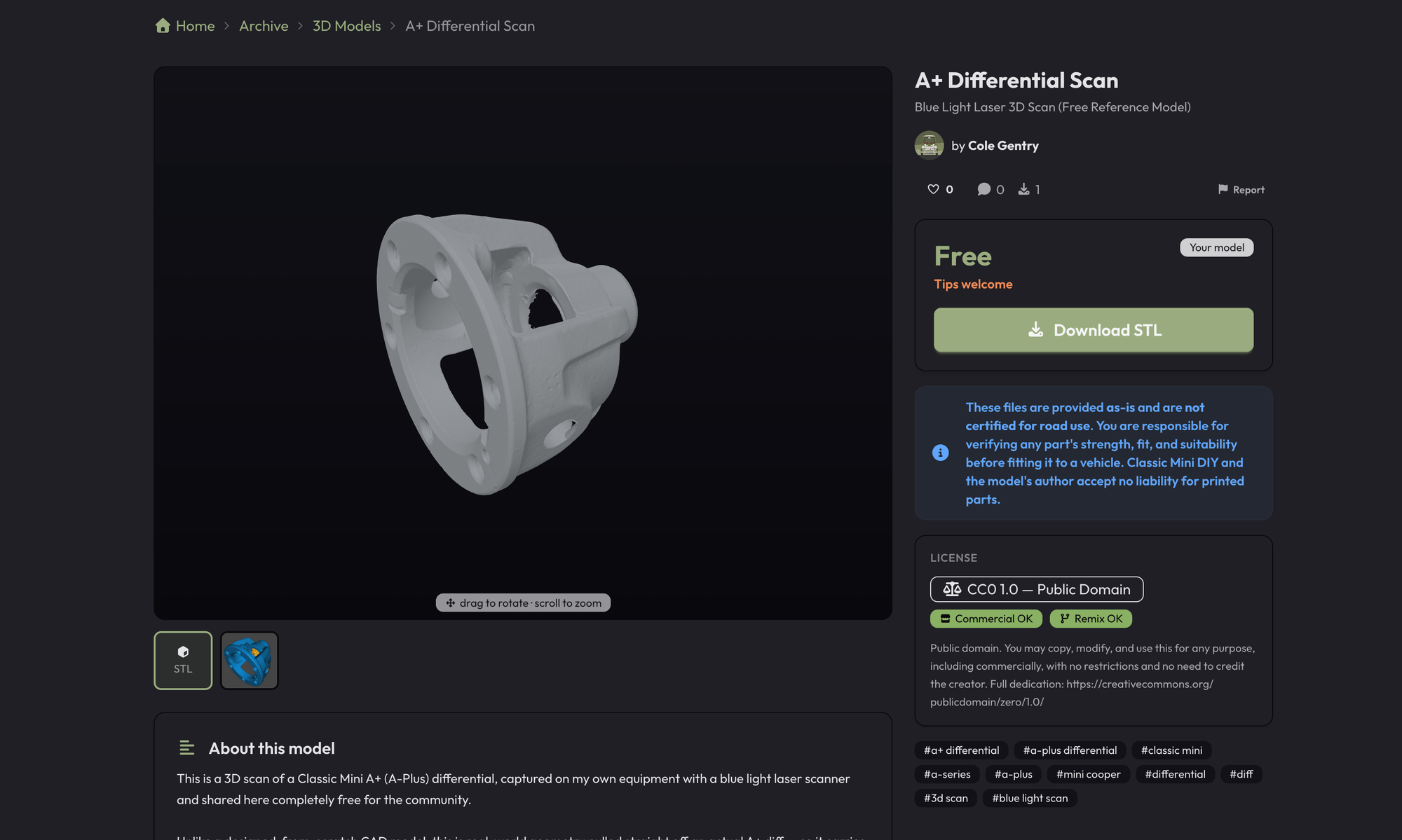
- A built-in 3D viewer so you can spin and inspect the part right in your browser before you print
- Clear licensing on every model, so you always know what you're allowed to do with it
Most models are free to download. Creators who want to can also accept tips or sell premium designs; but the default is "help your fellow Mini owners get the part they need."
Two ways to share

There are two ways to add to the library, and you'll see both the moment you go to share something:
Upload your own model.
If you've designed a part, upload your files along with the print settings, photos, and assembly notes. It goes through a quick review and then it's live for the whole community.
Share something you found online.
Found a brilliant Mini model on another site? You don't have to re-host it. Paste the link — from Thingiverse, Printables, MakerWorld, Cults3D, Thangs, MyMiniFactory, or anywhere else — and we'll automatically pull in the title, description, and a preview image. These listings sit right alongside everything else, marked with a badge showing where they came from and a button that sends you straight to the original to download. It's the fastest way to help the community find the good stuff, wherever it lives.
Turning your designs into a little income
Sharing is the heart of the library, and most models are free — but if you've put real work into a design, you can earn from it too. Here's how it works, in plain terms.
When you go to share a model, you pick how it's offered:
- Free — anyone can download it.
- Tips — free to download, with a "buy me a coffee" button for anyone who wants to say thanks.
- Pay what you want — you suggest a price, the buyer decides, with a minimum of $1.
- Fixed price — a set price, from $1 up.
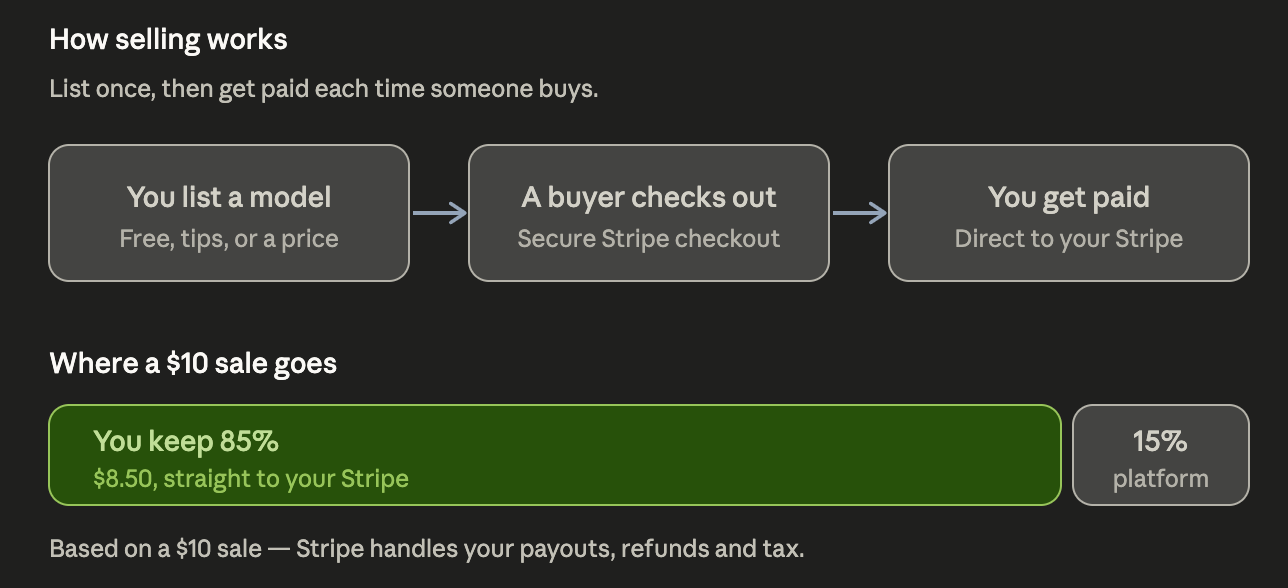
To get paid, you connect your own Stripe account. It takes a couple of minutes, and from then on the money flows straight to you. When someone buys your model, the payment lands in your account — and Classic Mini DIY keeps a flat 15% to cover hosting, payment processing, and keeping the library running. That's the whole deal: no monthly fees, no listing fees, no surprises. The same 15% applies to tips.
Because the sale runs through your own Stripe account, you're the seller of record — Stripe handles your payouts on its normal schedule, along with refunds and any tax that applies. Your work and your money stay yours.
And for buyers, it's just as simple: pay once, download instantly, and keep access to that model — and every future version of it — for good.
A quick word on safety
Some of these parts are purely decorative, plenty are genuinely functional, and a few touch areas where it matters; brakes, steering, structure, fuel. We flag safety-critical parts clearly, and I'd ask you to treat them with the respect they deserve. A printed gauge pod is one thing; anything that keeps you on the road is another. Print responsibly, and when in doubt, don't.
Get started
The library is live now and growing. Have a browse, sign in if you'd like to like and save models, and — if you've got something worth sharing — add it. Every part someone uploads or links is one more Mini kept on the road.
See you in the garage,
Cole — Classic Mini DIY